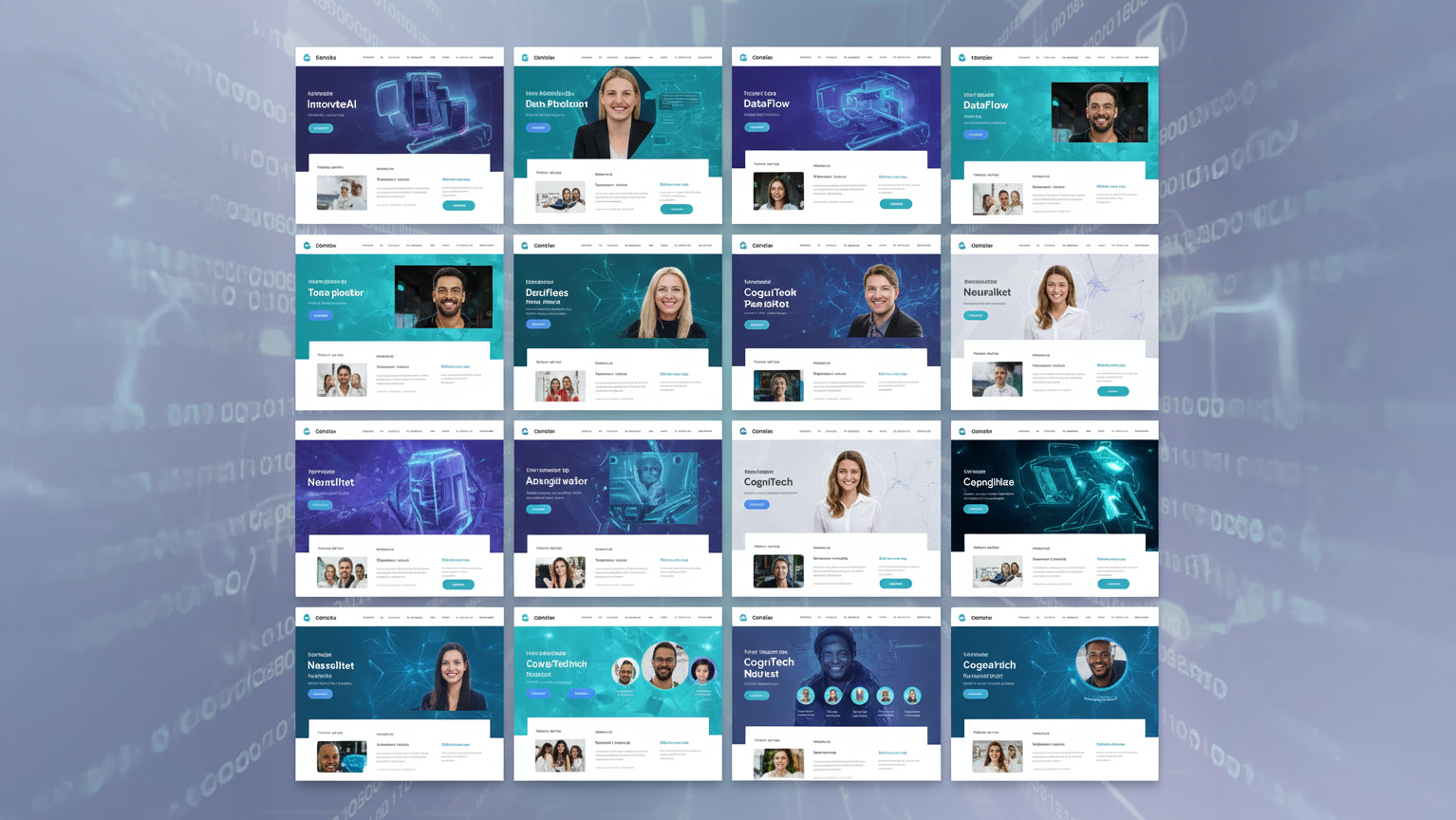
The Homogenisation of Web Design in the AI Era
Remember when every website was a WordPress theme with the same parallax scrolling and the same hero image layout? Well, congratulations-we’ve done it again, but faster this time.
AI-generated websites are everywhere. And if you’ve seen one, you’ve seen them all.
This isn’t hyperbole. Open ten different “AI-built” business websites and you’ll spot the pattern immediately: three-column feature sections, generic stock photos, the same vague copy structure, identical navigation patterns, and-my personal favourite-that inspirational quote block that says absolutely nothing specific about the actual business.
The promise was revolutionary. The reality is remarkably derivative.
When Automation Kills Creativity
Here’s what happened: AI website builders trained their models on thousands of existing websites. They learned patterns-what “works,” statistically speaking. Grid layouts, button placements, section structures, content hierarchies.
The problem? They learned the average. And the average is, by definition, unremarkable.
So when you ask an AI to “build me a modern business website,” it generates… the most statistically common interpretation of that request. Clean. Safe. Professional. Utterly forgettable.
It’s the digital equivalent of asking for a “nice car” and receiving a beige sedan. Technically correct. Functionally adequate. Completely devoid of personality.
The Template Trap at Scale
We’ve been here before.
In the early 2000s, everyone used the same Flash templates. Then came the WordPress theme epidemic-thousands of businesses with suspiciously similar-looking sites, just different logos and colours.
Now we have AI doing the same thing, just at a higher fidelity. The sites look more polished because AI has learned what “professional” means in 2026. But polished and generic is still generic.
The Difference This Time
What’s particularly insidious is how this homogenisation happens at the concept level, not just the visual level.
Traditional templates were visual constraints-you could still write distinctive copy and create unique imagery. AI generation goes deeper: it’s making structural decisions, content decisions, strategic decisions. And when those decisions are based on statistical averages of existing websites, you get average results.
Where Human Designers Still Win (Every Time)
Let me tell you what AI can’t do, no matter how sophisticated the model:
Understand Your Actual Business
Your competitive positioning, your unique value proposition, your target audience’s specific pain points. AI doesn’t interview your customers or understand your market dynamics.
Make Strategic Design Decisions
Why this layout supports your conversion goals. Why this colour palette reinforces your brand values. Why this content hierarchy guides users toward your desired outcomes. These aren’t statistical patterns-they’re strategic choices.
Create Authentic Differentiation
Real differentiation doesn’t come from templates or averages. It comes from understanding what makes your business genuinely different and expressing that visually and structurally.
Solve Unique Problems
Your business has specific challenges. Your website needs to address specific user needs. AI generates solutions to common problems using common patterns. Unique problems require custom thinking.
Evolve with Your Brand
A website isn’t a one-time build. It’s a living system that needs to grow, adapt, and change as your business evolves. AI can’t maintain strategic continuity across years of incremental improvements.
Here’s the uncomfortable truth: if AI can easily build your website, your website probably isn’t adding much value to your business. Because it’s not differentiated, it’s not strategic, and it’s not genuinely useful to your audience.
The Competency Paradox of AI Website Builders
Want to know the real problem with AI-generated websites? They look good enough to fool non-experts.
Five years ago, a bad website looked obviously bad-broken layouts, amateur design, poor mobile responsiveness. Anyone could spot it.
Today’s AI-generated sites look professional. They’re technically sound. The code works. The layout responds. The images are high-resolution. The copy is grammatically correct.
But scratch beneath the surface and you’ll find: no strategy, no competitive positioning, no understanding of user needs, no conversion optimisation, no brand thinking. Just an attractive shell with no substance.
The Dangerous Illusion
This is dangerous because businesses see these sites and think “good enough.” Then they wonder why their website doesn’t generate leads, doesn’t convert visitors, doesn’t differentiate them from competitors.
The website looks fine. The results are terrible. And because it looks fine, they can’t diagnose why.
When AI Genuinely Helps in Web Development
Does this mean AI has no place in web development? Of course not. But you need to understand where it adds value versus where it adds mediocrity.
AI is brilliant for:
Accelerating Implementation
Writing repetitive code, generating component variations, automating responsive breakpoints. If you know what you want to build, AI helps you build it faster.
Exploring Possibilities
Rapid prototyping of layout options, content structure experiments, colour palette generation. AI is fantastic for “show me five different ways to structure this page.”
Technical Problem-Solving
Debugging code, explaining browser compatibility issues, suggesting performance optimisations. When you have a specific technical challenge, AI is an excellent assistant.
Content Creation Support
First drafts of copy, SEO optimisation suggestions, alternative headline variations. Not final content, but useful starting points.
Notice the pattern? AI works when you’re the expert directing it. It fails when you’re expecting it to replace expertise you don’t have.
The Real Cost of Cheap Websites
Here’s what nobody talks about: AI-generated websites are cheap for a reason.
You save money upfront. Then you spend it-and more-on the back end:
- Conversion optimisation you have to do yourself because the AI didn’t understand your business model
- Brand consistency you have to fix because the AI didn’t understand your visual identity
- Content strategy you have to develop because the AI generated generic fluff
- Technical debt you accumulate because the AI generated functional but unmaintainable code
- Competitive differentiation you suffer because your website looks like everyone else’s
The website was cheap. The opportunity cost was expensive.
What 2026 Actually Demands from Websites
We’re not in 2010 anymore. Having a website isn’t enough. Your website needs to:
- Differentiate you clearly from competitors in an increasingly crowded market
- Convert visitors strategically through optimised user journeys and compelling calls-to-action
- Communicate value effectively to people who can choose from dozens of alternatives
- Reflect your brand authentically in a way that builds trust and credibility
- Support your business goals through strategic design and technical implementation
- Perform technically with speed, security, and accessibility
AI generating a templated site based on statistical averages of other businesses’ websites won’t achieve any of this. It can’t, because these outcomes require strategic thinking, not pattern recognition.
The Strategic Choice: Template vs Custom
So here’s your decision:
You can have an AI generate a website for you in minutes. It’ll look fine. It’ll work adequately. It’ll be exactly what everyone expects from a [your industry] company. And it’ll blend seamlessly into the background noise of the internet.
Or you can invest in strategic design and development. Understand your audience. Define your positioning. Create something that actually serves your business goals and differentiates you from competitors who took the easy route.
The first option is cheaper. The second option works.
AI Didn’t Kill Web Design (And Never Will)
Neither did WordPress, Squarespace, Wix, or any other democratisation tool that came before.
Here’s why: templates and generators can handle the commodity work-the basic, functional, “good enough” sites that honestly don’t need to be remarkable. If you’re a local plumber and just need contact details online, fine. Use whatever tool you want.
But if your website is a strategic business asset? If it needs to generate leads, communicate complex value, differentiate your positioning, and convert visitors into customers?
You need strategy. You need expertise. You need someone who understands both design and business. AI can help them work faster, but it can’t replace them.
The businesses thriving in 2026 understand this distinction. They’re not trying to eliminate expertise-they’re using AI to amplify it. They’re building websites that serve specific strategic purposes, not just checking the box of “having a website.”
The Actual Future of Web Design
Web design isn’t dying. It’s bifurcating.
On one side: commoditised template sites that all look similar because they’re all generated from the same patterns. Cheap, fast, adequate. For businesses where the website is just a necessity.
On the other side: strategically designed sites built by experts who understand business, users, and design-using AI to work faster, but not to replace thinking. For businesses where the website is a competitive advantage.
The gap between these two will widen throughout 2026 and beyond. The question is: which side do you want to be on?
If you’re tired of websites that look like everyone else’s and want something that actually serves your business strategy, let’s talk. We use AI to work efficiently-but we use human expertise to think strategically.