Most digital projects fail from slow decision-making, not bad execution. Analysis paralysis sets in. Committee approvals drag on. Decision authority becomes unclear. Goalposts move. Risk aversion paralyses action.
The organisations that move forward aren’t the ones with the most budget or the cleverest teams. They’re the ones with clear frameworks for making decisions. As a result, they can evaluate options quickly, gain consensus, and move to execution.
This article provides six decision frameworks that organisations can adapt for their own context. More importantly, these aren’t rigid templates. They’re structures that accelerate thinking rather than replace it.
Framework 1: Build vs Buy
The first decision is whether to use an existing platform or build something custom. This decision shapes everything downstream.
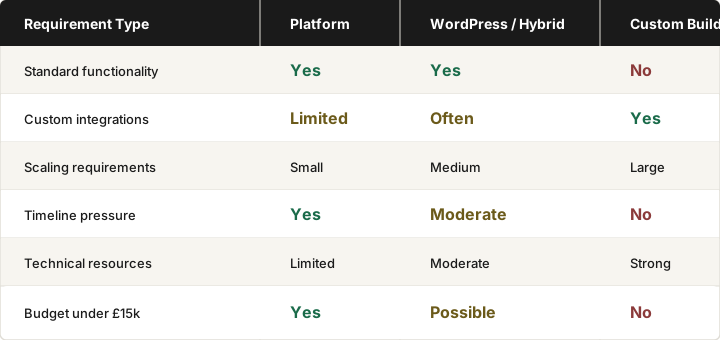
Use existing platforms when you have standard requirements that multiple providers address equally well. Specifically, if your needs fit within platform constraints and you don’t need custom integration, platforms are faster and cheaper. You should also consider platforms when speed to market is critical, when your technical resources are limited, or when your budget is under £15,000. Platforms reduce risk because they’re tested at scale. More importantly, they give you a product team maintaining the underlying system.
Build custom when you have unique requirements that platforms don’t address well. For example, when you need to scale significantly beyond what platforms handle, custom solutions often make sense. You should also consider custom builds when you need proprietary functionality, when existing platforms have technical limitations, or when you have capable technical resources internally. Build solutions also make sense when your budget allows for ongoing maintenance and iteration.
The Fulcrum case study demonstrates the build decision. They operate across multiple jurisdictions with different regulatory requirements. Platform solutions provide single-region compliance. Specifically, no off-the-shelf platform offered multi-jurisdiction compliance management. As a result, we built a custom plugin system that allowed jurisdiction-specific regulation handling within a coherent user experience.
This wasn’t overbuilding. This was the only honest solution to their constraint. More importantly, having the framework clarity meant they made the decision confidently rather than second-guessing later.
WordPress occupies a middle ground in this decision. It’s a platform with extensive plugin ecosystem, but you can customise it heavily. Specifically, WordPress works well for organisations that need more flexibility than standard SaaS platforms offer but have limited internal technical resources.
Here’s a simple decision matrix:
Framework 2: Agency selection criteria
Not all criteria for selecting an agency are equally important. More importantly, some things that feel important don’t actually predict project success.
What actually matters: relevant experience with similar scale projects, clear process and communication patterns, strategic thinking beyond just execution, technical capability that matches your needs, and post-launch support structure. Agencies with relevant experience in your domain understand your constraints without explanation. Clear processes mean you know what to expect. Strategic thinking means the agency pushes back on bad ideas. Technical capability should match complexity, not exceed it. Post-launch support prevents the abandoned-after-launch scenario.
What doesn’t matter as much: whether the portfolio looks aesthetically beautiful (because aesthetics are subjective), physical office location (because remote collaboration is standard), team size (because capability isn’t correlated with headcount), or awards and industry recognition (because awards rarely indicate client success).
Evaluate agencies using a weighted scoring system. Create a spreadsheet with your criteria listed. Score each agency 1-5 on each criterion. Apply weights based on importance for your specific project. As a result, you get a numerical comparison that removes some of the gut-feel bias.
Example scoring:
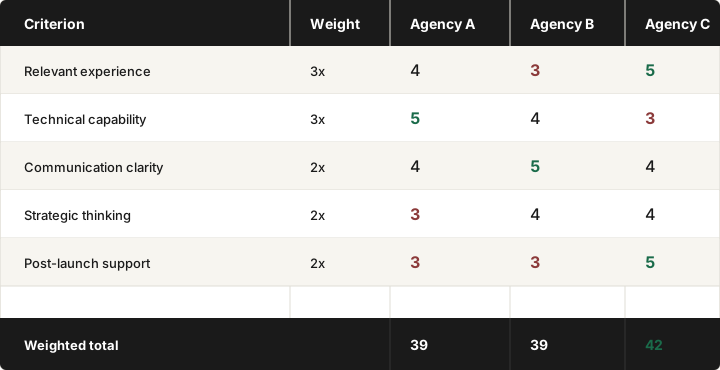
More importantly, this numerical comparison should inform your decision, not make it for you. If one agency scores higher but something feels off in conversation, trust that instinct.
Framework 3: Investment evaluation
Investment decisions need ROI logic, even when ROI isn’t perfectly calculable.
Start with a concrete example. Say you’re getting 10,000 monthly visitors. Your average deal value is £50,000. Currently, you’re converting at 0.5% (50 leads per month). A website redesign might improve conversion to 2% (200 leads per month). That’s an additional 150 leads per month, or 1,800 per year. If you close 30% of leads (your sales process), that’s 540 additional customers per year at £50,000 each. Revenue impact: £27 million annually from a £50,000 investment.
This is an oversimplification (some leads already exist, conversion doesn’t improve uniformly, implementation takes time), but it frames the thinking. More importantly, even with conservative numbers, the ROI usually justifies investment.
Create investment tiers that match common project types:
- £5k-£15k: Template-based sites, modest customisation, small content libraries. Appropriate for new businesses, side projects, or organisations with minimal traffic.
- £15k-£40k: Custom theme on standard platform, moderate functionality, moderate content. Appropriate for small businesses, non-profits, or standard service providers.
- £40k-£80k: Comprehensive redesign, significant custom functionality, large content library, multiple integrations. Appropriate for mid-market companies, regulated industries, or complex operations.
- £80k+: Platform build, extensive custom development, major integrations, significant technical complexity. Appropriate for scale-ups, enterprises, or unusual requirements.
The Validis project illustrates comprehensive investment evaluation. They committed £60k to a full rebrand and website rebuild. The decision was based on clear ROI: they were leaving money on the table because their brand positioning wasn’t reflecting their actual business. The investment delivered: 65% increase in click-through rate, 55% increase in average session duration. More importantly, these weren’t vanity metrics. They directly impacted qualified lead generation.
Don’t get bogged down trying to predict exact ROI. More importantly, work with realistic assumptions and evaluate whether the upside justifies the investment.
Framework 4: Risk assessment
Every project has risks. The framework involves identifying them and planning mitigation.
Common risks and mitigation:
- Timeline slippage: Mitigate with clear scope definition, realistic buffer time, and experienced vendors. More importantly, build in contingency weeks.
- Scope creep: Mitigate with documented scope, formal change request process, and clear decision authority. Specifically, every new feature requires removing something else or extending timeline.
- Stakeholder misalignment: Mitigate with clear decision-making authority defined upfront, stakeholder communication throughout the project, and documented success criteria. More importantly, have the hard conversations before you start.
- Technical issues: Mitigate with discovery work that surfaces constraints, experienced technical leads, and testing time. Specifically, don’t skip discovery hoping to save time.
- Poor agency fit: Mitigate with thorough evaluation, trial projects if possible, clear communication preferences, and reference checks. More importantly, poor fit compounds over a long project.
- Underwhelming results: Mitigate with realistic success criteria defined in advance, meaningful measurement, and post-launch optimisation budget. As a result, you’re measuring actual impact rather than hoping it went well.
Document your risks, their likelihood, their impact, and your mitigation. This prevents surprises and guides decision-making when problems arise.
Framework 5: Timeline evaluation
Realistic timelines matter more than optimistic ones. Red flags indicate projects at risk.
Green flags include: agencies that explain timeline components rather than just stating a number; timelines that include buffer for unknowns; realistic content planning accounting for migration time; testing time included before launch; post-launch support planned.
Red flags include: timelines that feel rushed (less than six weeks for anything substantial); no discovery phase; content planning treated as afterthought; testing compressed to final week; no post-launch support mentioned; timeline stated as firm regardless of scope clarity.
The FlexFactor project exemplifies timeline realism. They estimated 10 weeks for a custom WordPress build with modest integrations and clear content scope. This wasn’t aggressive. It was realistic. More importantly, they delivered on that timeline because the estimate accounted for discovery, design, development, testing, and launch phases.
Compare this to an agency quoting six weeks for similar work. Either their definition of “weeks” is very loose, or they’re setting themselves up for slippage.
Framework 6: Decision matrix
Bring these frameworks together into a single scorecard when you’re comparing options.
Create a table with your project’s key decision criteria. Weight them by importance. Score options. Look at the total. More importantly, use this to structure conversation rather than let it be the final answer.
Example decision matrix for “Should we redesign our website now or wait”:
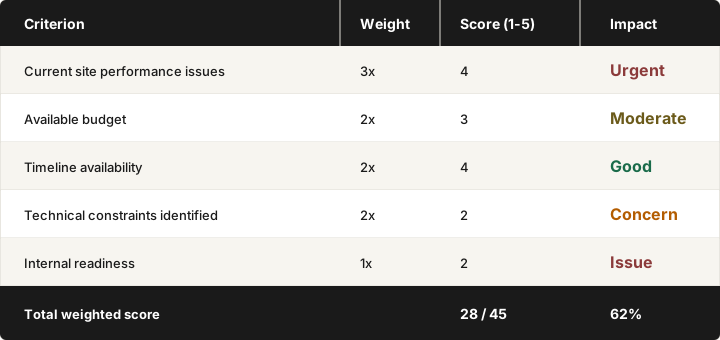
A score of 62% says “this is worth doing, but resolve some constraints first.” It’s not a go/no-go. It’s a thinking tool.
One-week decision process
Compress decisions using a structured process:
- Monday: Gather the brief. Circulate reading materials and context. More importantly, frame the decision clearly (not “should we redesign” but “should we start in September or October?”).
- Tuesday-Wednesday: Stakeholders review, form opinions, ask clarifying questions. More importantly, this is when concerns surface that need addressing.
- Thursday: Discussion and synthesis. Address concerns. Test assumptions. More importantly, focus on resolving blockers rather than re-litigating the core decision.
- Friday: Decision. More importantly, document what you decided, why you decided it, and what success looks like. This prevents revisiting the decision when the project gets hard.
This doesn’t mean snap decisions on major investments. More importantly, it prevents the months-long committee process that kills momentum.
The Secomak example: clear frameworks, confident decisions
Secomak faced a straightforward decision: their 90-year-old manufacturing business needed a modern website to capture online enquiries. The product complexity (100+ specifications across different markets) meant this wasn’t a small project. More importantly, the decision was clear.
Build versus buy: custom WordPress build made sense. Secomak had specific requirements around product specification management and regional configuration that platforms didn’t address well. Specifically, WordPress provided the flexibility without pure custom development costs.
Investment justification: rough ROI maths showed that a 30% increase in organic enquiries would pay for the investment within four months. This made the decision easy.
Timeline clarity: 14 weeks was realistic given 100+ product pages and regional requirements. More importantly, Secomak built this into their planning.
As a result, the project executed smoothly. Timeline was met. Content work was coordinated. Results were strong: 100% traffic increase, 60% of new enquiries from organic search.
Summary
Clear frameworks accelerate decisions. They don’t eliminate judgment. More importantly, they structure thinking so organisations can move from analysis to action.
Use the build-versus-buy framework to decide whether existing platforms work or custom builds are necessary. Use agency selection criteria and weighted scoring to choose partners strategically. Use investment evaluation to frame ROI in business terms. Use risk assessment to identify and mitigate problems early. Use timeline evaluation to catch unrealistic estimates.
Most importantly, use decision matrices to bring these together into coherent choices. Confidence comes not from having perfect information, but from having clear thinking.
Read the planning guide for more detail: How to Plan Your Website Project Without Wasting Time.
Read about timelines: The Real Cost of Waiting Until Q4.
Case studies: Validis, FlexFactor, Fulcrum, Horizon Global Partners, and Secomak.
Sector-specific service pages: all sectors, financial services, technology, manufacturing, and start-ups. The 4D Framework covers our underlying process.
Frequently asked questions
How do we know if an agency is right for us without a trial project?
Reference checks help. Specifically, ask for two references from projects similar in scale and complexity to yours. Ask those references whether the agency met timeline commitments, whether they communicated clearly, whether they pushed back on bad ideas, and whether they provided post-launch support. More importantly, ask whether they’d hire the agency again. References who hesitate are telling you something.
Should we score agencies numerically or trust our gut?
Numerical scoring removes some bias, but gut instinct matters. More importantly, use scoring to structure conversation, not replace judgment. If an agency scores high numerically but something feels off in conversation, explore that feeling.
What if our timeline constraints conflict with quality requirements?
They usually do. More importantly, this is a legitimate tension to address explicitly. Be specific: “We need to launch in October. Given that constraint, what scope of work is realistic?” Let the agency recommend scope reduction rather than promising delivery on unrealistic timelines.
How detailed should success criteria be?
Specific enough to measure, but not so prescriptive that you lock yourself into one solution. “Increase qualified leads by 20% within six months” is good. “Improve click-through rate on the blog section by exactly 17.4%” is too specific. More importantly, focus on business outcomes (leads, revenue, cost reduction) rather than activity metrics (page views, time on page).
What if stakeholders disagree about which framework matters most?
That’s a valid disagreement to surface early. More importantly, different stakeholder perspectives matter. A finance stakeholder will weight ROI heavily. A product stakeholder might weight timeline and capability. A brand stakeholder might weight strategic thinking. Getting these weights explicit prevents surprises later. Specifically, if your CFO discovers halfway through that they thought the decision was based on financial criteria they weren’t consulted on, trust has broken.