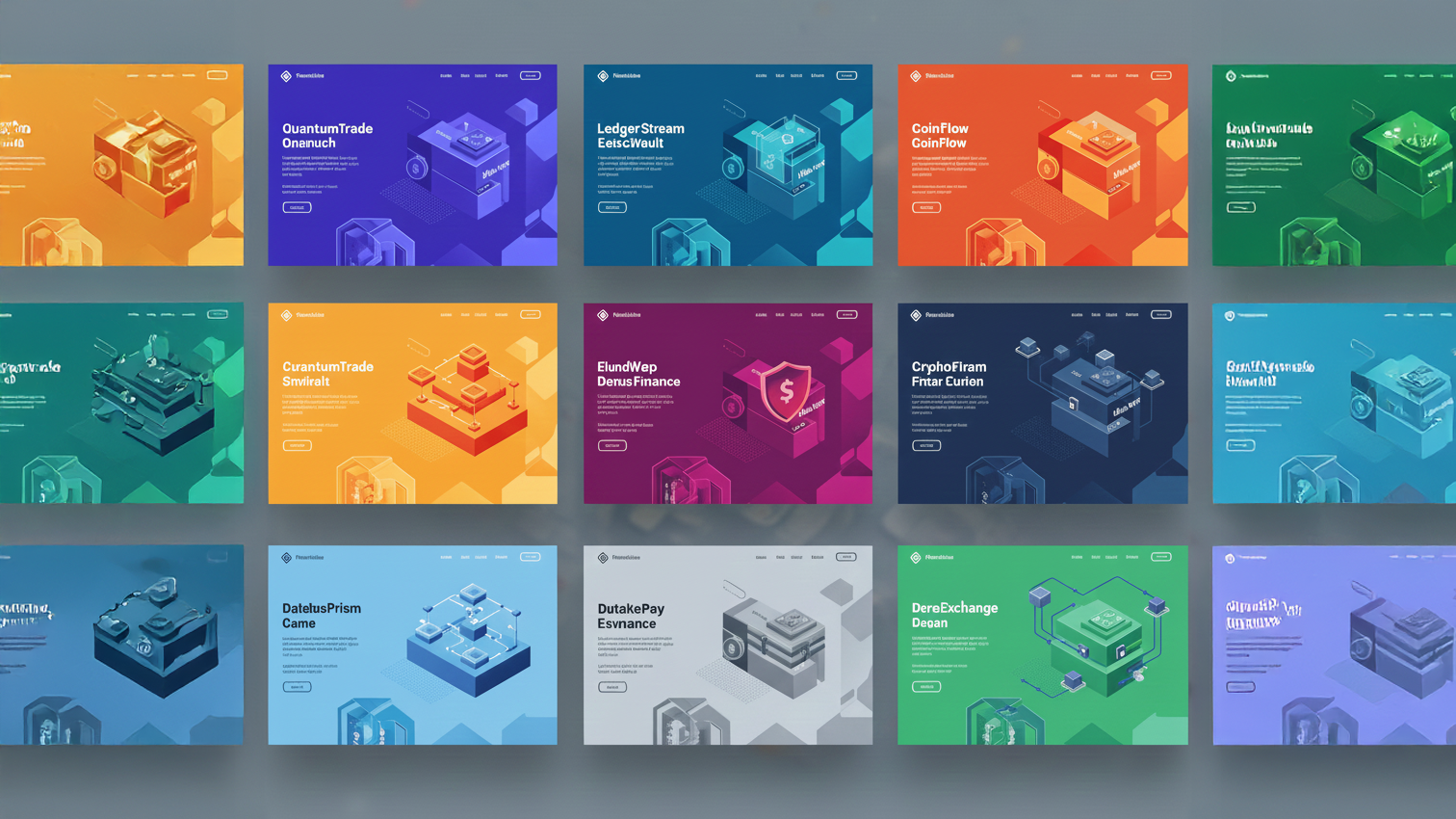
Why do all fintechs look the same?
Open ten fintech websites. You’ll immediately see:
- Gradient backgrounds (usually purple to blue, or teal to green)
- Geometric shapes floating in space
- Sans-serif typefaces (typically Circular, Inter, or SF Pro)
- Isometric illustrations or abstract 3D elements
- The same three-column feature layout
- Identical hero sections with “The future of finance is here”
They’re all professionally designed. All technically well-executed. All completely indistinguishable. This isn’t an accident. This means the entire fintech industry is following the same playbook. As a result, it’s costing fintech companies their ability to differentiate on anything except price.
How the fintech branding formula became universal
In 2015, a handful of fintech companies – Revolut, Monzo, TransferWise (now Wise), Stripe – broke away from traditional financial services aesthetics. They were consumer-focused. Mobile-first. Design-led. Specifically, they looked nothing like banks.
And it worked. Brilliantly. They proved that financial services didn’t have to look conservative, corporate, or boring. More importantly, they showed that “innovative” could be a visual language, not just a feature set.
Then everyone copied them.
The fintech branding playbook that became universal
By 2018, there was an established formula:
- Visual language – Tech-forward, optimistic, accessible
- Colour palette – Bright, saturated, gradients that suggest movement and innovation
- Typography – Geometric sans-serifs that feel modern and clean
- Imagery – Abstract, not photographic. Illustrations over stock photos
- Layout – Lots of white space, asymmetric grids, bold headlines
Design agencies packaged this into templates. SaaS website builders made it accessible. Every new fintech founder looked at successful companies and thought “we should look like that.” The problem? Everyone had the same thought.
The pattern recognition problem in fintech branding
Here’s what actually happened: the industry learned the wrong lesson.
The lesson was supposed to be: “Differentiate your visual identity to match your actual positioning.” Instead, the lesson people took was: “Copy what successful fintechs look like.”
Revolut didn’t succeed because of gradients. Specifically, they succeeded because they solved a real problem (foreign exchange fees) with a better solution (real exchange rates). The visual identity reinforced their positioning as innovative challengers.
When you copy the visual language without the differentiated positioning, you get the aesthetic without the substance. As a result, you look innovative, but you haven’t communicated what you’re actually innovating on.
How should B2B fintech branding differ from consumer fintech?
Here’s the critical distinction the fintech industry missed: Consumer fintech (B2C) and institutional fintech (B2B) require completely different visual languages.
Consumer fintech serves retail customers. They’re competing against traditional banks. Looking different is strategic. This means it signals “we’re not like them.”
Institutional fintech serves hedge funds, asset managers, banks, insurance companies. Specifically, they’re competing on operational sophistication, security, regulatory compliance, integration capabilities.
When you look like a consumer fintech startup while trying to sell to institutional clients, you’re sending mixed signals. You’re saying “we’re innovative” when they need you to say “we’re reliable, secure, and compliant.”
What makes fintech branding strategic rather than generic?
Financial services – even fintech – is fundamentally about trust. Consumer fintech builds trust through simplicity, transparency, and accessibility. The visual language supports that: bright, friendly, approachable.
Institutional fintech builds trust through sophistication, security, and operational excellence. Specifically, the visual language should support that: professional, robust, credible.
How institutional fintech branding should work
When an institutional buyer evaluates a fintech platform, they’re assessing specific capabilities:
- Technical sophistication – Can this handle our complexity? Our volume? Our requirements?
- Security and compliance – Do they understand regulatory requirements? Data protection? Audit trails?
- Operational maturity – Is this a startup that might disappear in 18 months, or a sustainable business?
- Integration capabilities – Can they work with our existing systems? Our data formats? Our processes?
- Support and reliability – What happens when something breaks? What’s their uptime? Their response time?
None of these are communicated by gradient backgrounds and geometric shapes. In fact, consumer-focused fintech aesthetics actively undermine institutional credibility. You look like a B2C startup when you need to look like a B2B platform.
How do you differentiate a fintech brand in a crowded market?
When everyone looks the same, differentiation becomes impossible through visual identity alone. I recently reviewed 15 portfolio management platforms. All B2B institutional fintech. All looked virtually identical: same colour schemes, same layouts, same typography, same imagery style.
Reading through their value propositions reveals the pattern:
- “AI-powered portfolio analytics”
- “Real-time risk management”
- “Seamless integration”
- “Built for institutional investors”
- “Enterprise-grade security”
Same words. Same claims. Same visual language. The only way to differentiate? Price. Features. Integration lists. Everything that can be easily copied by competitors.
Why fintech branding uniqueness matters
When visual identity is genericised, you lose the ability to communicate positioning at a glance. Prospects can’t tell you apart until they read your entire website, compare your feature lists, and evaluate your pricing. As a result, that’s exhausting. Most don’t bother. They stick with what they know or go with whoever they met first.
Your brand identity should do work for you. Specifically, it should communicate “we’re for X type of client” or “we solve Y specific problem” or “we approach this differently by Z.” Generic fintech aesthetics communicate nothing except “we’re a fintech company.” Which isn’t a positioning. It’s a category.
Breaking the Pattern Requires Strategy, Not Just Different Colours
The solution isn’t “be different for the sake of being different.”
The solution is: understand your actual positioning, and create visual identity that reinforces it.
Start With Strategic Questions
Before you touch any design tools:
Who exactly are you for?
Consumer retail investors? Wealth management firms? Institutional asset managers? Banks? Insurance companies? Each requires different trust signals.
What problem do you uniquely solve?
Not “we’re better” – what do you do differently? What trade-offs have you made? What do you refuse to compromise on?
What’s your actual differentiation?
Technology architecture? Regulatory expertise? Specific market focus? Integration capabilities? Client service model?
Where do you sit in the market?
Challenger to established platforms? Enterprise solution? Niche specialist? Your visual identity should reflect your position.
What’s the maturity stage?
Early-stage startup? Growth-stage scale-up? Established platform? Different stages require different visual languages.
Then Design to Your Answers
If you’re building enterprise software for institutional asset managers, don’t look like a consumer neobank.
If you’re a regulatory compliance platform, reliability and security matter more than innovation signals.
If you’re focused on wealth management firms, sophistication and trustworthiness trump accessibility and friendliness.
If you’re genuinely disruptive, your visual identity can be bold. If you’re incrementally better, your identity should signal professional competence.
Case Study: Strategic fintech branding that breaks the pattern
We worked with Fulcrum Asset Management on their digital transformation. They’re not fintech. Specifically, they’re a £8bn+ asset manager. But the challenge was similar: create visual identity that matches institutional sophistication.
The challenge
Fulcrum needed brand identity that worked across multiple contexts:
- Credible to institutional investors
- Appropriate for a global asset manager
- Modern without looking like a startup
- Professional across all major markets (London, New York, Tokyo)
- Scalable as they grow
The approach
We didn’t follow fintech branding patterns. As a result, we created identity appropriate for their positioning:
- Sophisticated colour palette – Professional but distinctive, appropriate for institutional context
- Custom graphic toolkit – Bespoke elements, not stock illustrations or generic shapes
- Clear information hierarchy – Emphasis on clarity and functionality over aesthetic trends
- Professional photography – Real team, real offices, real credibility
- Typography that signals seriousness – Not trendy, not corporate-boring, appropriately professional
See the Fulcrum case study for more on how strategic identity transforms institutional positioning.
The result
Visual identity that actually reflects their sophistication. They don’t look like other asset managers (differentiated), but they also don’t look like a fintech startup (appropriate). The identity scales across all materials: website, fund factsheets, investor presentations, regulatory documents, marketing collateral.
What Good Looks Like
For Consumer Fintech (B2C)
- Accessibility over sophistication – Clear, friendly, simple
- Trust through transparency – Open about fees, process, policies
- Innovation signals – You’re not like traditional banks (visually or functionally)
- Mobile-first experience – Most interaction happens on phones
- Emotional connection – Financial services that don’t feel intimidating
For Institutional Fintech (B2B)
- Sophistication over accessibility – Your clients are professionals, talk to them as such
- Trust through competence – Demonstrate technical capability, security, compliance
- Reliability signals – You’re a long-term partner, not a risky startup
- Desktop-focused experience – Institutional users work on multiple screens
- Professional credibility – Financial services for financial professionals
For Both
- Clear differentiation – Visual identity that matches actual positioning
- Consistent system – Not just a logo, a complete visual language
- Strategic, not trendy – Won’t look dated in 18 months
- Authentic expression – Reflects genuine business capabilities
The path forward for fintech brand differentiation
If your fintech company looks like every other fintech company, you have two choices:
Option 1: Embrace commoditisation
Accept that you’re competing on features and price. Focus on operational efficiency. Race to the bottom on pricing. Hope your feature set remains differentiated (it won’t).
Option 2: Strategic differentiation
Get clear on your actual positioning. Create visual identity that reinforces it. Communicate what makes you genuinely different. Build brand that does work for you. This isn’t about being trendy. This means being strategic.
Strategic questions for fintech branding
Before your next rebrand or website redesign, ask these questions:
Are we consumer-focused or institutional-focused?
Different audiences require different visual languages. Don’t use consumer aesthetics for institutional clients.
What trust signals does our audience need?
Innovation? Reliability? Security? Sophistication? Your visual identity should reinforce the appropriate signals.
What’s our actual competitive positioning?
Challenger? Enterprise? Niche specialist? Your identity should reflect your position in the market.
Are we following patterns or creating strategy?
If your visual identity could work for any fintech company, it’s not strategic. It’s generic.
Will this still be appropriate in 3-5 years?
Trend-based design dates quickly. Strategic design scales with your business.
The competitive advantage of authentic fintech branding
In 2026, looking like a professional fintech company is table stakes. Everyone can do that. The competitive advantage is looking like YOUR fintech company. With clear positioning. Appropriate for your audience. Differentiated from competitors. Strategic, not trendy.
Gradients and geometric shapes might look nice. But they don’t communicate why someone should choose you over the dozen other platforms that look exactly the same. Strategic brand identity does.
For related perspectives on institutional expectations, see The Single-Page Hedge Fund and Market Perception vs Market Reality in Financial Services. For sector-specific service pages, see fintech branding, financial services, and our case studies for Validis, Horizon Global Partners, and MAIA Technology.
Frequently Asked Questions
Q: Isn’t all fintech design supposed to look modern and innovative?
A: Modern, yes. Identical, no. There’s a difference between “modern design principles” and “copying every other fintech visually.” Modern should mean your design reflects current best practices for your specific audience. Consumer fintech and institutional fintech have different modern standards.
Q: How do we know if our fintech branding is strategic or generic?
A: Strategic fintech branding communicates your specific positioning. If you removed your logo and name, would investors still understand what type of fintech you are and who you serve? If not, your branding is likely generic.
Q: Won’t differentiated branding make us look unprofessional?
A: Strategic differentiation and professionalism aren’t mutually exclusive. In fact, they’re complementary. Professional fintech branding means appropriate for your context. Institutional clients expect sophistication. Consumer clients expect accessibility. Your visual identity should reflect that distinction clearly.
Q: Should our fintech company avoid trendy design altogether?
A: Not entirely. Trends reflect what the market finds credible at that moment. The issue is when trends replace strategy. Use current design language appropriately, but ensure it reinforces your actual positioning rather than just copying what others do.
Q: How does fintech brand differentiation affect funding or partnerships?
A: Investors and partners evaluate fintech companies partly through brand perception. A generic fintech brand sends a signal that you haven’t thought deeply about positioning. Strategic branding demonstrates clarity about your market, your audience, and your differentiation. That clarity instils confidence.
If your fintech brand looks like everyone else’s and you’re ready to differentiate strategically, we should talk. We specialise in financial services branding that matches your actual positioning, whether you’re consumer-focused, institutional, or somewhere in between.